
Geopolitical Pressure and Strategic Responses of MNEs in China
Article Sidebar
Main Article Content
Abstract
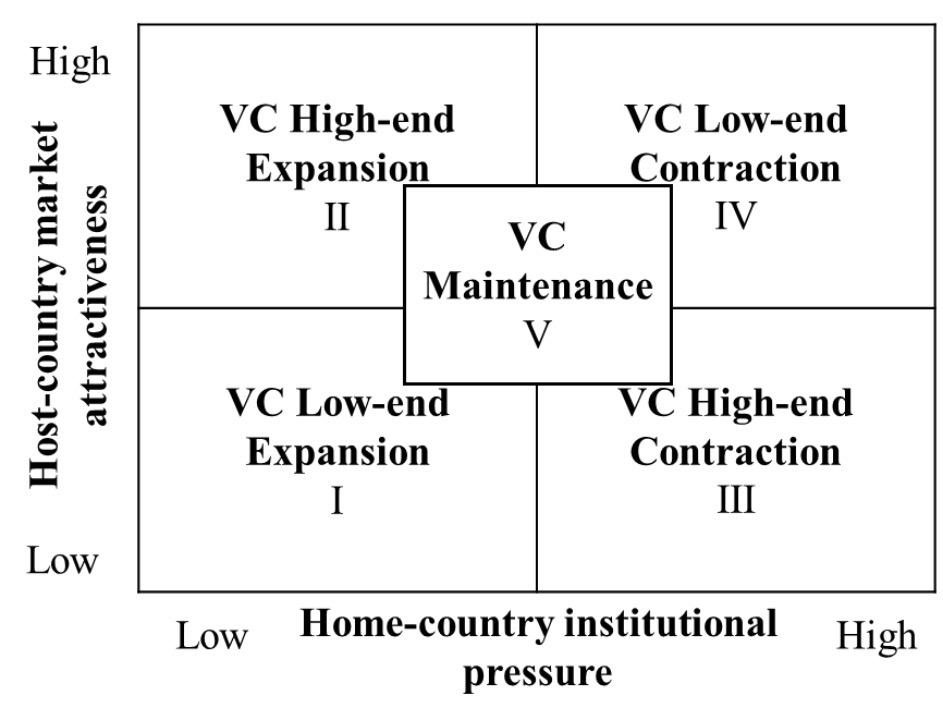
The geopolitical pressure for decoupling from China has become a defining feature of the new globalization, reflected in Western governments’ efforts to limit dependence on China and enhance technological competitiveness and value chain (VC) resilience. As a result, multinational enterprises (MNEs) in China face heightened home-country institutional constraints that compel them to reassess and reconfigure their VCs. Drawing on institutional theory and global value chain research, we develop a conceptual framework explaining how MNEs in China respond to such home-country institutional pressure while evaluating host-country market opportunities. The framework identifies five distinct VC reconfiguration strategies, capturing how firms balance political conformity with economic rationality. By systematically linking geopolitical pressure to firm-level strategic responses, this paper contributes to international business scholarship by providing a theoretical lens for understanding strategic heterogeneity under conditions of geopolitical disruption.
Downloads
Article Details
Section

This work is licensed under a Creative Commons Attribution 4.0 International License.
How to Cite
References
Boussebaa, M., & Morgan, G. (2014). Pushing the Frontiers of Critical International Business Studies. Critical Perspectives on International Business, 10, 96-106. https://doi.org/10.1108/cpoib-11-2013-0046
Buckley, P.J., & Casson, M. (2019). Decision-making in International Business. Journal of International Business Studies, 50, 1424-1439.https://doi.org/10.1057/s41267-019-00244-6
Cui, V., Vertinsky, I., Wang, Y., & Zhou, D. (2023). Decoupling in International Business: the ‘New’ Vulnerability of Globalization and MNEs’ Response Strategies. Journal of International Business Studies, 54(8), 1562-1576. https://doi.org/10.1057/s41267-023-00602-5
Dean, J.W. & Sharfman, M.P. (1996). Does Decision Process Matter? A Study of Strategic Decision-Making Effectiveness. Academy of Management Journal, 39, 368-392. https://doi.org/10.2307/256784
De Villa, M.A., Rajwani, T., Lawton, T.C. & Mellahi, K. (2019). To Engage or Not to Engage with Host Governments: Corporate Political Activity and Host Country Political Risk. Global Strategy Journal, 9, 208–242.https://doi.org/10.1002/gsj.1205
European Commission. (2023). Report from the Commission to The European Parliament and the Council Third Annual Report on The Screening of Foreign Direct Investments into the Union. https://eur-lex.europa.eu/legal-content/EN/TXT/?uri=celex:52023DC0590.
Gavetti, G. (2012). Perspective—Toward a Behavioral Theory of Strategy. Organization Science, 23(1), 267-285. https://doi.org/10.1287/orsc.1110.0644
Greenwood, R., Raynard, M., Kodeih, F., Micelotta, E. R., & Lounsbury, M. (2011). Institutional Complexity and Organizational Responses. Academy of Management Annals, 5(1), 317-371. https://doi.org/10.5465/19416520.2011.590299
Grimes, S., & Du, D. (2022). China's Emerging Role in the Global Semiconductor Value Chain. Telecommunications Policy, 46(2), 101959.https://doi.org/10.1016/j.telpol.2020.101959
Gupta, A., Briscoe, F., & Hambrick, D. C. (2017). Red, Blue, and Purple Firms: Organizational Political Ideology and Corporate Social Responsibility. Strategic Management Journal, 38(5), 1018-1040. https://doi.org/10.1002/smj.2550
Hillman, A. J., Withers, M. C., & Collins, B. J. (2009). Resource Dependence Theory: A Review. Journal of Management, 35(6), 1404-1427. https://doi.org/10.1177/0149206309343469
Li, J., Xia, J., & Lin, Z. (2018). Cross-border Acquisitions by State-owned Firms: How Do Legitimacy and Home-country Institutions Matter? Journal of World Business, 53(5), 690-704. https://doi.org/10.1002/smj.2609
Liu, X., Hassan, J., Gao, H., & Sharma, R. R. (2025). A Typology of De-Coupling in International Sourcing by MNEs in Selective De-Globalization. Journal of International Management, 101304. https://doi.org/10.1016/j.intman.2025.101304
Luo, Y. (2022). Illusions of Techno-Nationalism. Journal of International Business Studies, 53(3), 550-567. https://doi.org/10.1057/s41267-021-00468-5
Luo, Y., & Van Assche, A. (2023). The Rise of Techno-Geopolitical Uncertainty: Implications of the United States Chips and Science Act. Journal of International Business Studies, 54(8), 1423-1440. https://doi.org/10.1057/s41267-023-00620-3
Maitland, E., & Sammartino, A. (2015). Managerial Cognition and Internationalization. Journal of International Business Studies, 46(7), 733-760. https://doi.org/10.1057/jibs.2015.9
Meng, B., Gao, Y., Zhang, T., Ye, J., & Zhang, Y. (2025). The US–China Relations and the Impact of the US–China Trade War: Global Value Chains Analyses. Economic Analysis and Policy, 87, 1896-1908. https://doi.org/10.1016/j.eap.2025.07.038
Meyer, K. E., & Peng, M. W. (2016). Theoretical Foundations of Emerging Economy Business Research. Journal of International Business Studies, 47(1), 3-22. https://doi.org/10.1057/jibs.2015.34
Moura, S.T.G., Lawton, T.C. & Tobin, D. (2025). How do Multinational Enterprises Respond to Geopolitics? A Review and Research Agenda. International Journal of Management Reviews, 1-21. https://doi.org/10.1111/ijmr.12399
Müllner, J. & Puck, J. (2018). Towards a Holistic Framework of MNE-State Bargaining: A Formal Model and Case-Based Analysis. Journal of World Business, 53, 15-26. https://doi.org/10.1016/j.jwb.2017.07.003
Oliver, C. (1991). Strategic Responses to Institutional Processes. Academy of Management Review, 16(1), 145-179. https://doi.org/10.2307/258610
Peng, X., Liang, Y., Wang, Y., & Zhou, S. S. (2025). How do MNEs Respond to Internationalization Tensions under “New Globalization”: A Paradoxical View. Journal of International Management, 101296. https://doi.org/10.1016/j.intman.2025.101296
Rugman, A. M., & Verbeke, A. (2007). Liabilities of Regional Foreignness and the Use of Firm-Level Versus Country-Level Data: A Response to Dunning et al. (2007). Journal of International Business Studies, 38(1), 200-205. https://doi.org/10.1057/palgrave.jibs.8400242
Teece, D. J. (2014). The Foundations of Enterprise Performance: Dynamic and Ordinary Capabilities in an (Economic) Theory of Firms. Academy of Management Perspectives, 28(4), 328-352. https://doi.org/10.5465/amp.2013.0116
The White House. (2023). Executive Order on Addressing United States Investments in Certain National Security Technologies and Products in Countries of Concern. https://bidenwhitehouse.archives.gov/briefing-room/presidential-actions/2023/08/09/executive-order-on-addressing-united-states-investments-in-certain-national-security-technologies-and-products-in-countries-of-concern/
Thornton, P., & Ocasio, W. (2008). Institutional logics. In R. Greenwood, C. Oliver, R. Suddaby, K. Sahlin (Eds.) Institutional logics (pp. 99-128). SAGE Publications Ltd, https://doi.org/10.4135/9781849200387.n4
U.S. Department of Commerce, Bureau of Industry and Security. (2022). Commerce Implements New Export Controls on Advanced Computing and Semiconductor Manufacturing Items to the People’s Republic of China. https://www.bis.doc.gov/index.php/documents/about-bis/newsroom/press-releases/3158-2022-10-07-bis-press-release-advanced-computing-and-semiconductor-manufacturing-controls-final/file
Witt, M. A., & Lewin, A. Y. (2007). Outward Foreign Direct Investment as Escape Response to Home Country Institutional Constraints. Journal of International Business Studies, 38(4), 579-594. https://doi.org/10.1057/palgrave.jibs.8400285
Witt, M. A., Lewin, A. Y., Li, P. P., & Gaur, A. (2023). Decoupling in International Business: Evidence, Drivers, Impact, and Implications for IB Research. Journal of World Business, 58(1), 101399. https://doi.org/10.1016/j.jwb.2022.101399
Yan, Z. J., Zhu, J. C., Fan, D., & Kalfadellis, P. (2022). Multinational Enterprises and Home Country Institutional Pressure. Journal of Management Inquiry, 31(2), 165-180. https://doi.org/10.1177/1056492620970285