
Beyond the State: Social Identity Theory and the Psychological Pathway of Foreign Policy Decision-Makers
Article Sidebar
Main Article Content
Abstract
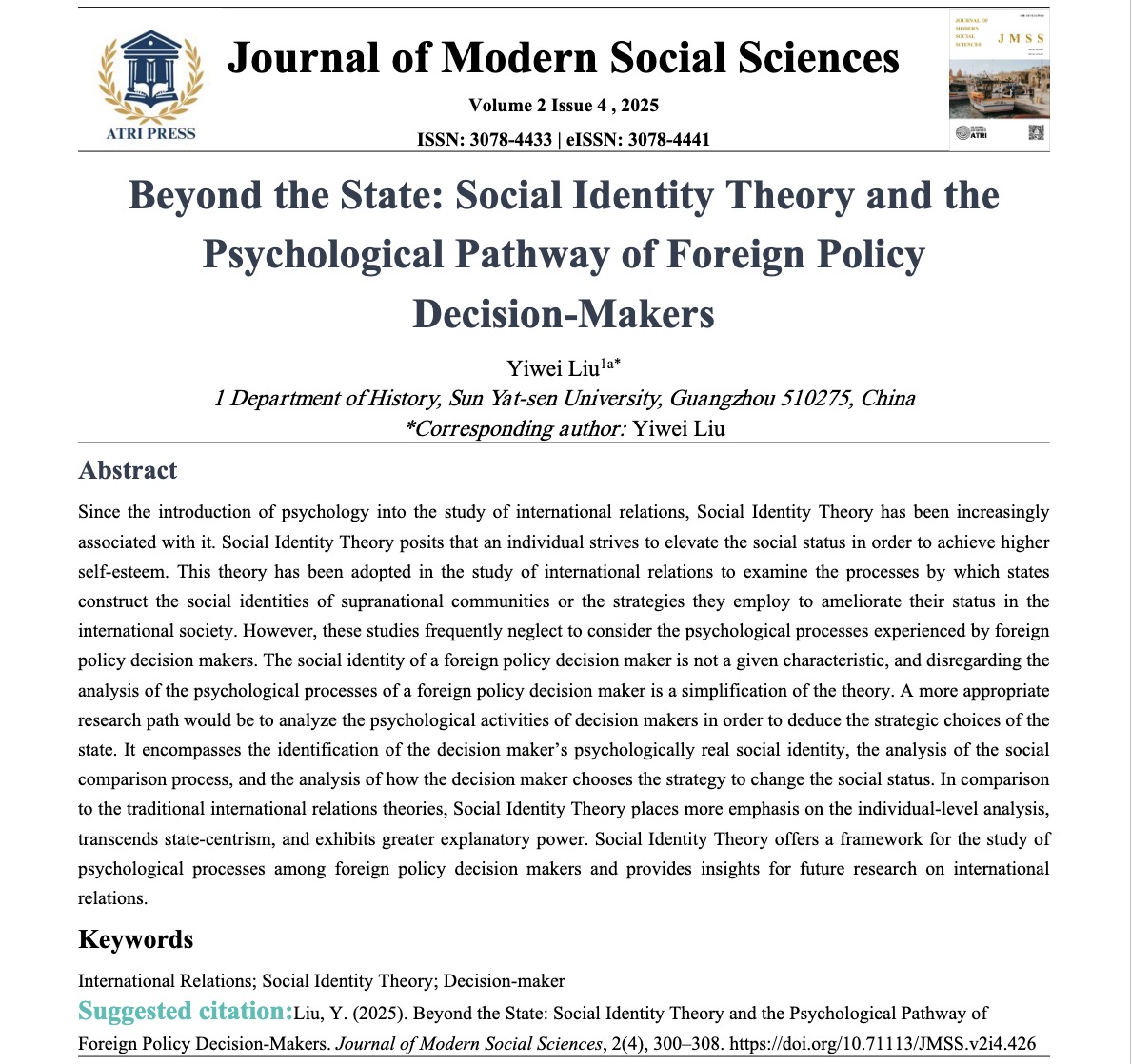
Since the introduction of psychology into the study of international relations, Social Identity Theory has been increasingly associated with it. Social Identity Theory posits that an individual strives to elevate the social status in order to achieve higher self-esteem. This theory has been adopted in the study of international relations to examine the processes by which states construct the social identities of supranational communities or the strategies they employ to ameliorate their status in the international society. However, these studies frequently neglect to consider the psychological processes experienced by foreign policy decision makers. The social identity of a foreign policy decision maker is not a given characteristic, and disregarding the analysis of the psychological processes of a foreign policy decision maker is a simplification of the theory. A more appropriate research path would be to analyze the psychological activities of decision makers in order to deduce the strategic choices of the state. It encompasses the identification of the decision maker’s psychologically real social identity, the analysis of the social comparison process, and the analysis of how the decision maker chooses the strategy to change the social status. In comparison to the traditional international relations theories, Social Identity Theory places more emphasis on the individual-level analysis, transcends state-centrism, and exhibits greater explanatory power. Social Identity Theory offers a framework for the study of psychological processes among foreign policy decision makers and provides insights for future research on international relations.
Downloads
Article Details
Section

This work is licensed under a Creative Commons Attribution 4.0 International License.
How to Cite
References
Abrams D. (2001). Social identity, psychology of. In Neil J. Smelser and Paul B. Baltes, eds., International Encyclopedia of the Social & Behavioral Sciences, 14306-14309.
Allison, G. (2017). Destined for War: Can America and China Escape Thucydides’s Trap?, Boston: Houghton Mifflin Harcourt.
Chen, Z. (2013). Status seeking and norm building: Emerging powers’ incentive to the building of international human rights norms. World Economies and Politics, 2013(5), 114-135.
Gilpin, R. (1981). War and Change in World Politics, Cambridge: Cambridge University Press.
Gravelle, T. B., Reifler J., Scotto T. J. (2020). Personality traits and foreign policy attitudes: A cross-national exploratory study. Personality and Individual Differences, 153:109607.doi: 10.1016/j.paid.2019.109607
Gries, P. (2005). Social psychology and the identity-conflict debate: Is China threat inevitable. European Journal of International Relations, 11(2), 235-265. doi: 10.1177/1354066105052966
Hogg, M. A., et al. (2004). The social identity perspective: Intergroup relations, self-conception, and small groups. Small Group Research, 35(3), 246-276.doi: 10.1177/1046496404263424
Jackson, J.W. (1993). Realistic Group Conflict Theory: A review and evaluation of the theoretical and empirical literature. The Psychological Record, 43(3), 395-414.
Janis, I. L. (1982) Groupthink: Psychological Studies of Policy Decisions and Fiascoes, Boston: Houghton Mifflin Company.
Jervis, R. (1976). Perception and Misperception in International Politics. Princeton: Princeton University Press.
Larson D. W., Shevchenko A. (2003). The new thinking and the revolution in Soviet foreign policy. International Organization, 57(1), 77-109.doi: 10.1017/S0020818303571028
Larson D. W., Shevchenko A. (2010). Status seekers: Chinese and Russian responses to U.S. primacy. International Security, 34(4), 63-95.doi: 10.1162/isec.2010.34.4.63
Larson, D. W. (2017). Social identity theory: Status and identity in international relations. In Oxford research encyclopedia of politics. doi:10.1093/acrefore/9780190228637.013.290
Larson D. W., Shevchenko A. (2019). Quest for Status: Chinese and Russian Foreign Policy, New Haven: Yale University Press.
Lebow, R. N. (2010). Why Nations Fight: Past and Future Motives for War, Cambridge: Cambridge University Press.
Lee, J. J. (2016). Will China’s rise be peaceful? A social psychological perspective. Asian Security, 12(1), 29-52. doi:10.1080/14799855.2016.1140644
Li, M. (2003). The European integration theory of constructivism. Chinese Journal of European Studies, 2003(3), 48-58.
Li, M. (2009). Formation of collective identity in international relations: A European social psychological perspective. World Economics and Politics, 2009(5), 66-73.
Liu, F. (2019). Paradigm synthesis and the reconstruction of international relations theory - an analysis of the realist example. Social Sciences in China, 2019(8), 187-203.
Milner, H. V. (1997) Interests, Institutions, and Information: Domestic Politics and International Relations, Princeton: Princeton University Press.
Park, A., Jakstaite-Confortola, G. (2021). Small state status-seeking: Lithuania’s foreign policy status aspirations. Europe-Asia Studies, 73(7), 1279-1302. doi: 10.1080/09668136.2021.1919291
Reicher, S. (2004). The context of social identity: Domination, resistance, and change. Political Psychology, 25(6), 921-945. doi: 10.1111/j.1467-9221.2004.00403.x
Tajfel, H. (1970). Experiments in intergroup discrimination. Scientific American, 223(5), 96-103. doi: 10.1038/scientificamerican1170-96
Tajfel, H. (1974). Social identity and intergroup behaviour. Social Science Information, 13(2), 65-93. doi: 10.1177/053901847401300204
Tajfel H., Turner J. C. (1986) The social identity of untergroup behavior. In Stephen Worchel and William G. Austin, eds., Psychology of Intergroup Relations, Chicago: Nelson-Hall, 7-24.
Tang, S. (2018). Idea, Action, and Outcome: The Objects and the Tasks of Social Sciences. World Economics and Politics, 2018(5), 33-59.
Turner J. C. (1975). Social comparison and social identity: Some prospects for intergroup. European Journal of Social Psychology, 5(1), 5-34.
doi: 10.1002/ejsp.2420050102
Turner, J. C., & Brown, R. (1978). Social status, cognitive alternatives and intergroup relations. Differentiation between social groups: Studies in the social psychology of intergroup relations, 201-234.
Turner, J. C., Hogg, M. A., Oakes P., et al. (1987). Rediscovering the Social Group: A Self-Categorization Theory, Oxford: Basil Blackwell.
Wohlforth W. C. (2009). Unipolarity, status competition, and great power war. World Politics, 61(1), 28-57. doi: 10.1017/s0043887109000021
Wohlforth W. C., de Carvalho, B., Leira, H., et al. (2018). Moral authority and status in international relations: Good states and the social dimension of status seeking. Review of International Studies, 44(3), 526-546.doi: 10.1017/s0260210517000560
Yang, S., Wang S. (2018). Regional Integration in Central Asia from the Perspective of Social Identity Theory. Russian Studies, 2018(3), 45-75.