Optimizing Regulatory Pathways for Generative Artificial Intelligence in China: A Policy-Analytic Study
Article Sidebar
Main Article Content
Abstract
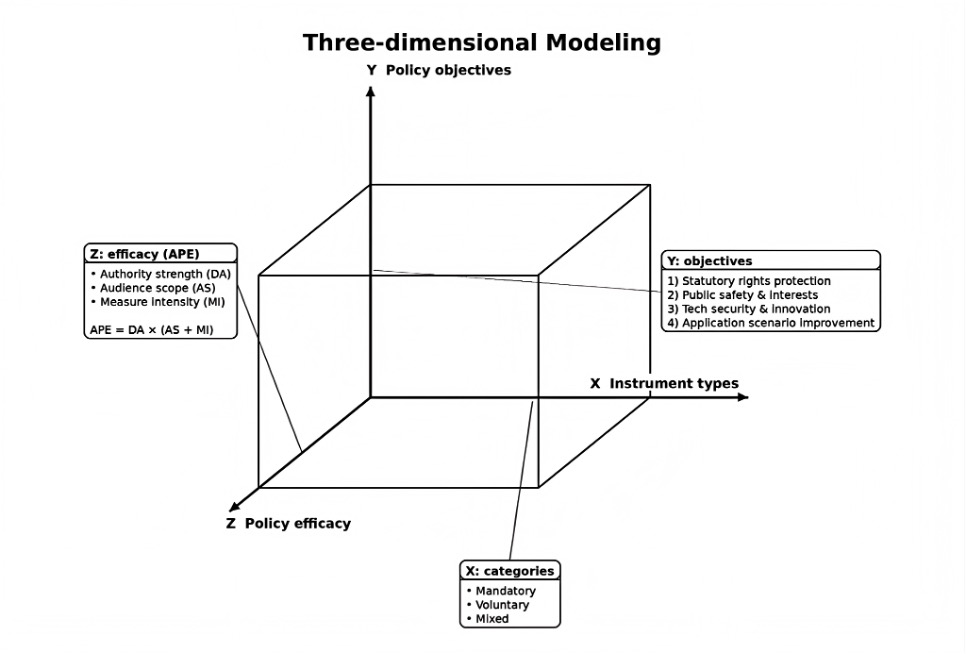
This paper takes China's regulatory policies for generative artificial intelligence (AI) as the research subject and develops a three-dimensional analytical framework titled "Policy Instrument–Policy Objective–Policy Effectiveness" by employing the policy instrument approach and content analysis methodology. Against the challenges prevailing in China’s current generative AI regula-tion—including the uneven distribution of regulatory resources, the complexity of horizontal and vertical regulatory coordination, the regulatory system’s over-reliance on coercive mechanisms, and the fragmentation tendency of regulatory policies—the study proposes four optimized pathways: first, establish a closed-loop mechanism of "piloting–evaluation–scaling"; second, build a gov-ernment-led multi-center collaborative governance framework that integrates enterprise internal control, third-party evaluation, and industry self-regulation; third, advance model-based regulation for the "model–version–scenario" unit; fourth, implement controllable pilots via regulatory sandboxes to accumulate empirical experience.
Downloads
Article Details
Section

This work is licensed under a Creative Commons Attribution 4.0 International License.
How to Cite
References
1. Gao, X., & Yan, Y. (2025). Composite regulatory governance framework and optimization of generative artificial intelligence services in China: A mixed study based on policy texts and in-depth interviews. E-Government, (5), 2–15. In Chinese.
2. Lorenz, P., Perset, K., & Berryhill, J. (2023). Initial policy considerations for generative artificial intelligence. OECD Artificial Intelligence Papers, No. 1.
3. Wan, B. (2024). Obligation subjects and obligational allocation in generative AI regulation: A case study of ChatGPT. Journal of Taiyuan University of Technology (Social Science Edition), 42(3), 29–35, 44.
4. Liu, P., & Yang, Y. (2025). A comparative study of provincial policies on generative artificial intelligence regulation: Based on the analysis of policy texts and filing results. E-Government, (5), 16–30. In Chinese.
5. Xing, Y., & Qi, K. (2024). On the artificial intelligence regulatory policies of the current U.S. government. International Review, (4), 31–57. In Chinese.
6. Schiff, D. S. (2023). Looking through a policy window with tinted glasses: Setting the agenda for U.S. AI policy. Review of Policy Research, 40(5), 729–756.
7. Musthafa, A. R., & Arundhati, G. B. (2025). Artificial intelligence governance beyond borders: The EU AI Act’s influence on third-party legal frameworks and regional organizations. Review of European and Com-parative Law. Advance online publication.
8. Jorge-Ricart, R., & Álvarez-Aragonés, P. (2023). The geopolitics of generative AI: International implications and the role of the European Union 〔Working paper〕. Real Instituto Elcano.
9. Wang, J. (2017). Introduction to government regulation economics. The Commercial Press. In Chinese.
10. Wang, S., Shen, L., Wang, S., et al. (2019). Bibliometric analysis of research literature on health information policies in the past decade. Chinese Journal of Health Information Management, 16(1), 34–38. In Chinese.
11. Zhou, J., & Tou, L. (2025). Policy coordination for green agricultural development in China: A text mining analysis. Journal of Chinese Governance, 1–29. https://doi.org/10.1080/23812346.2025.2523170
12. Liu, Y., & Ma, H. (2025). Evaluation of China’s ESG policy texts based on the “instrument-theme-subject” framework. Sustainability, 17(17), 7796. https://doi.org/10.3390/su17177796
13. Huang, X., Gao, J., & Zhang, H. (2023). Low-carbon eco-city development policy in China: A bibliometric analysis of policy documents. Kybernetes, 52(2), 601–624. https://doi.org/10.1108/K-02-2022-0230
14. Yuan, Z. (2024). Administrative regulatory dilemmas of generative artificial intelligence and their solutions. Journal of Shaanxi Academy of Governance, 38(3), 33–39. In Chinese.
15. Fan, Z., & Tan, H. (2017). A quantitative literature study of local government big data development policies: From the perspective of “objectives–tools” matching. Chinese Public Administration, (12), 46–53. In Chinese.
16. Howlett, M., & Ramesh, M. (1995). Studying public policy: Policy cycles and policy subsystems. Oxford University Press.
17. Tan, C., Liang, Y., Wei, W., et al. (2022). Textual measurement and optimization of China’s science and technology talent evaluation policies from a four-dimensional analytical perspective. Information Science, 40(3), 63–71. In Chinese.
18. Peng, J., Sun, W., & Zhong, W. (2008). An empirical study on the evolution and performance of China’s technological innovation policies, 1978–2006. Science Research Management, (4), 134–150. In Chinese.
19. Meng, G., Wu, S., & Yu, Y. (2025). Forestry policy effectiveness and performance evaluation in China: Quantitative study based on policy texts 1998–2020. Forest Policy and Economics, 170, 103367. https://doi.org/10.1016/j.forpol.2024.103367
20. Chen, T., Hou, P., Wang, B., & Yang, J. (2025). Analysis of fertility policy differences based on policy continuity and policy effectiveness in China. Biodemography and Social Biology, 70(3), 138–164. https://doi.org/10.1080/19485565.2025.2527033
21. Guo, J., & Wang, Y. (2022). Research on the optimization and adjustment of rural ecological policies from the perspective of Chinese modernization. Journal of Northwest University (Philosophy and Social Sciences Edition), 52(6), 147–161. In Chinese.
22. Zhao, Y., Chen, Y., & Chen, Y. (2018). Evaluation of cross-border e-commerce policies based on the PMC index model. Journal of International Business, (6), 114–126. In Chinese.
23. Cheng, Q., Dong, J., & Chen, Y. (2021). Evaluation of original innovation policies in the context of the in-novative country strategy. Studies in Science of Science, 39(12), 2281–2293. In Chinese.
24. Xu, W., & He, Y. (2025). Institutional system and optimization path of safety regulation for generative arti-ficial intelligence: A grounded analysis based on 51 policy texts. Journal of Gansu Administration Institute, (3), 77–89. In Chinese.