 ATRI
 Open Access Statement
Inflation Persistence and Expectations Formation in the Post-Pandemic Economy: A Narrative Review
* Corresponding author
Main Article Content
Abstract
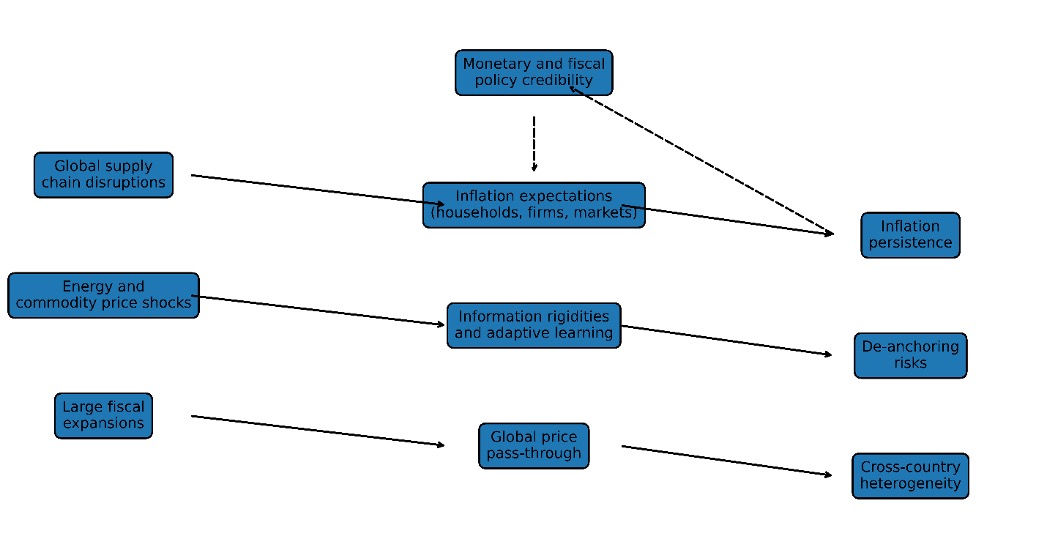
The sharp rise in inflation following the COVID 19 pandemic has upended many of the assumptions that had been held about the nature of inflation, how it is expected, and the effectiveness of policy. After decades when prices remained relatively stable in many economies, inflation re-emerged as a key macroeconomic problem and turned out to be more persistent and widespread than initially thought. This paper reviews and synthesizes the literature on post pandemic inflation, looking at the issue from a worldwide perspective. The authors contend that the persistence of inflation cannot be solely accounted for by demand or supply factors in isolation, but rather it is the interaction of large global shocks, expectations formation, supply side constraints and monetary fiscal policy interactions that determines it. The paper, by mapping the literature onto four themes inflation persistence after large shocks, expectations anchoring, globalization and supply side transmission, and the role of monetary fiscal frameworks helps to understand why inflation has stayed high in many countries and why the results have differed. The review points to the consequences of these mechanisms for inflation targeting and macroeconomic policy making in a world where large shocks are likely to recur. In sum, the paper is a valuable input in the academic and policy debates that are going on by providing an integrated framework for understanding inflation persistence in a globally interconnected economy.
Article image
Downloads
Article Details
Section

This work is licensed under a Creative Commons Attribution 4.0 International License.
Citation & export
References
1. Angeloni, I., Aucremanne, L., Ehrmann, M., Galí, J., Levin, A., & Smets, F. (2006). New evidence on inflation persistence and price stickiness in the euro area: Implications for macro modeling. Journal of the European Economic Association, 4(2-3), 562-574. https://doi.org/10.1162/jeea.2006.4.2-3.562 DOI: https://doi.org/10.1162/jeea.2006.4.2-3.562
2. Attinasi, M.-G., & Balatti, M. (2024). Inflation comovement in emerging economies: The facts and impact of global prices. Journal of Asian Economics, 91, 101794. https://doi.org/10.1016/j.asieco.2024.101794 DOI: https://doi.org/10.1016/j.asieco.2024.101794
3. Baumeister, C., & Kilian, L. (2016). Forty years of oil price fluctuations: Why the price of oil may still surprise us. Journal of Economic Perspectives, 30(1), 139-160. https://doi.org/10.1257/jep.30.1.139 DOI: https://doi.org/10.1257/jep.30.1.139
4. Benati, L. (2008). Investigating inflation persistence across monetary regimes. The Quarterly Journal of Economics, 123(3), 1005-1060. https://doi.org/10.1162/qjec.2008.123.3.1005 DOI: https://doi.org/10.1162/qjec.2008.123.3.1005
5. Bianchi, F., & Ilut, C. (2017). Monetary/fiscal policy mix and agents’ beliefs. Journal of Monetary Economics, 89, 46-63. https://doi.org/10.1016/j.jmoneco.2016.11.006 DOI: https://doi.org/10.1016/j.jmoneco.2016.11.006
6. Bianchi, F., & Melosi, L. (2017). Escaping the Great Recession. American Economic Review, 107(4), 1030-1058. https://doi.org/10.1257/aer.20160186 DOI: https://doi.org/10.1257/aer.20160186
7. Blanchard, O. (2019). Public debt and low interest rates. American Economic Review, 109(4), 1197-1229. https://doi.org/10.1257/aer.109.4.1197 DOI: https://doi.org/10.1257/aer.109.4.1197
8. Carroll, C. D. (2003). Macroeconomic expectations of households and professional forecasters. The Quarterly Journal of Economics, 118(1), 269-298. https://doi.org/10.1162/00335530360535207 DOI: https://doi.org/10.1162/00335530360535207
9. Chen, Y., & Serletis, A. (2025). Monetary policy strategies in advanced and emerging economies. Open Economies Review, 36, 1-23. https://doi.org/10.1007/s11079-024-09751-y DOI: https://doi.org/10.1007/s11079-024-09751-y
10. Ciccarelli, M., & Mojon, B. (2010). Global inflation. The Review of Economics and Statistics, 92(3), 524-535. https://doi.org/10.1162/REST_A_00008 DOI: https://doi.org/10.1162/REST_a_00008
11. Coibion, O., & Gorodnichenko, Y. (2015). Information rigidity and the expectations formation process: A simple framework and new facts. American Economic Review, 105(8), 2644-2678. https://doi.org/10.1257/aer.20110306 DOI: https://doi.org/10.1257/aer.20110306
12. Coibion, O., Gorodnichenko, Y., & Kamdar, R. (2018). The formation of expectations, inflation, and the Phillips curve. Journal of Economic Literature, 56(4), 1447-1491. https://doi.org/10.1257/jel.20171300 DOI: https://doi.org/10.1257/jel.20171300
13. Cogley, T., & Sargent, T. J. (2005). Drifts and volatilities: Monetary policies and outcomes in the post WWII US. Review of Economic Dynamics, 8(2), 262-302. https://doi.org/10.1016/j.red.2004.10.009 DOI: https://doi.org/10.1016/j.red.2004.10.009
14. Cogley, T., Primiceri, G. E., & Sargent, T. J. (2010). Inflation-gap persistence in the United States. American Economic Journal: Macroeconomics, 2(1), 43-69. https://doi.org/10.1257/mac.2.1.43 DOI: https://doi.org/10.1257/mac.2.1.43
15. Corsetti, G., & Dedola, L. (2016). The mystery of the printing press: Monetary policy and self-fulfilling debt crises. Journal of International Economics, 99, 83-102. https://doi.org/10.1016/j.jinteco.2015.12.008 DOI: https://doi.org/10.1016/j.jinteco.2015.12.008
16. Devereux, M. B., & Yetman, J. (2010). Price-setting behaviour and inflation persistence: Evidence from the United Kingdom. Journal of Money, Credit and Banking, 42(1), 149-176. https://doi.org/10.1111/j.1538-4616.2009.00270.x DOI: https://doi.org/10.1111/j.1538-4616.2010.00330.x
17. Enders, Z., & Holt, M. T. (2019). The direct effects of energy prices on U.S. consumer prices: Symbolic, passive, or substantial? Journal of Money, Credit and Banking, 51(7), 1721-1744. https://doi.org/10.1111/jmcb.12632 DOI: https://doi.org/10.1111/jmcb.12632
18. Faishal, M. (2019). Impact of global economic crisis on Indian economy: A study of external sector. IMPACT: International Journal of Research in Humanities, Arts and Literature, 7(3), 103–116.
19. Faishal, M., Mathew, S., Neikha, K., Pusa, K., & Zhimomi, T. (2023). The future of work: AI, automation, and the changing dynamics of developed economies. World Journal of Advanced Research and Reviews, 18(3), 620–629. https://doi.org/10.30574/wjarr.2023.18.3.1086 DOI: https://doi.org/10.30574/wjarr.2023.18.3.1086
20. Gopinath, G., Boz, E., Casas, C., Díez, F. J., Gourinchas, P.-O., & Plagborg-Møller, M. (2020). Dominant currency paradigm. American Economic Review, 110(3), 677-719. https://doi.org/10.1257/aer.20171201 DOI: https://doi.org/10.1257/aer.20171201
21. Leeper, E. M. (1991). Equilibria under “active” and “passive” monetary and fiscal policies. Journal of Monetary Economics, 27(1), 129-147. https://doi.org/10.1016/0304-3932(91)90007-B DOI: https://doi.org/10.1016/0304-3932(91)90007-B
22. Mankiw, N. G., & Reis, R. (2002). Sticky information versus sticky prices: A proposal to replace the New Keynesian Phillips curve. The Quarterly Journal of Economics, 117(4), 1295-1328. https://doi.org/10.1162/003355302320935034 DOI: https://doi.org/10.1162/003355302320935034
23. Pivetta, F., & Reis, R. (2007). The persistence of inflation in the United States. Journal of Economic Dynamics and Control, 31(4), 1326-1358. https://doi.org/10.1016/j.jedc.2006.05.001 DOI: https://doi.org/10.1016/j.jedc.2006.05.001
24. Stock, J. H., & Watson, M. W. (2007). Why has U.S. inflation become harder to forecast? Journal of Money, Credit and Banking, 39(s1), 3-33. https://doi.org/10.1111/j.1538-4616.2007.00014.x DOI: https://doi.org/10.1111/j.1538-4616.2007.00014.x
25. Weber, M., D’Acunto, F., Gorodnichenko, Y., & Coibion, O. (2022). The subjective inflation expectations of households and firms: Measurement, determinants, and implications. Journal of Economic Perspectives, 36(3), 157-184. https://doi.org/10.1257/jep.36.3.157 DOI: https://doi.org/10.1257/jep.36.3.157
26. Woodford, M. (2001). Fiscal requirements for price stability. Journal of Money, Credit and Banking, 33(3), 669-728. https://doi.org/10.2307/2673890 DOI: https://doi.org/10.2307/2673890