 ATRI
ATRI 

 Open Access Statement
The Olympic Sports Evaluation Model Based on Entropy Weight Method and Improved TOPSIS
Main Article Content
Abstract
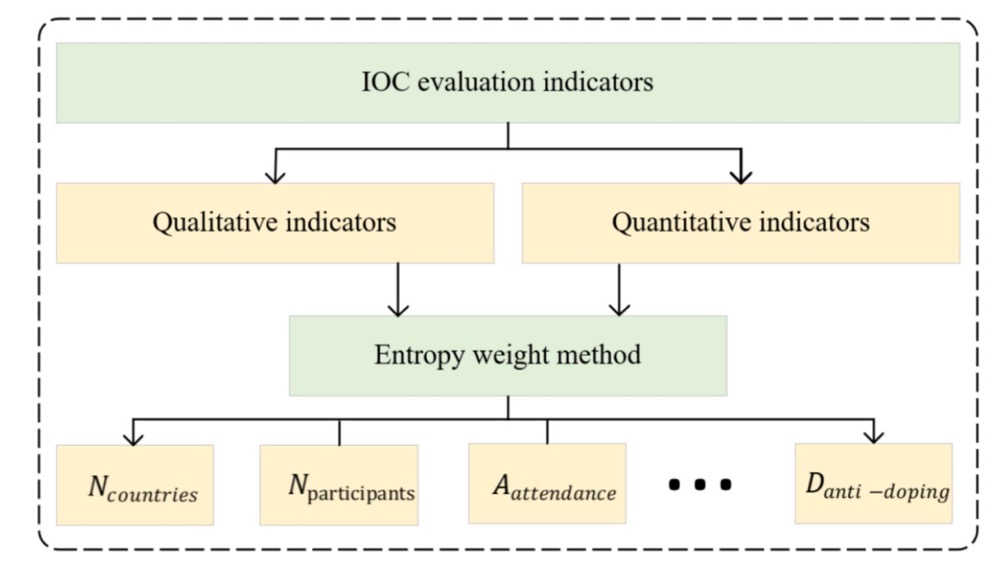
Since the revival of the Olympic Games in 1896, the Olympics has evolved into one of the most important global sporting events. With the passage of time, the International Olympic Committee (IOC) has worked continuously to maintain the relevance and influence of the Games, introducing, adjusting, or removing sports to ensure that the competition aligns with the needs and expectations of global audiences. As such, developing a scientific and rational evaluation framework to determine whether a sport should be added or removed from the Olympic Games is crucial. This paper proposes a sports evaluation model to assess whether Olympic sports align with the core values of the Games. The model is based on six key evaluation dimensions: Popularity and Accessibil- ity, Gender Equity, Sustainability, Inclusivity, Relevance and Innovation, and Safety and Fair Play. It combines 12 quantitative indicators and 10 qualitative indicators to construct a 22-element evaluation matrix. The entropy weight method is then used to calculate the weights of each indicator, followed by the application of the TOPSIS method to determine the ideal and negative ideal solutions. The sports are then evaluated by calculating the distance between each sport’s score and the ideal solution. The higher the score, the more aligned the sport is with the Olympic core values.
Article image
Downloads
Article Details
Section

This work is licensed under a Creative Commons Attribution 4.0 International License.
Citation & export
References
Lv, X., Shi, N., Wei, J., Tian, Y., Li, J., & Li, J. (2021, December). Information System Security Risk Assessment Based on Entropy Weight Method-Bayesian Network. In International Conference on Frontiers in Cyber Security (pp. 152-162). Singapore: Springer Singapore.
https://doi.org/10.1007/978-981-19-0523-0_10
Yadav, R. (2021). Analytic hierarchy process‐technique for order preference by similarity to ideal solution: a multi criteria decision‐making technique to select the best dental restorative composite materials. Polymer Composites, 42(12), 6867-6877.
https://doi.org/10.1002/pc.26346
Muthulakshmi, P., & Parveen, M. (2023). Z-Score Normalized Feature Selection and Iterative African Buffalo Optimization for Effective Heart Disease Prediction. International Journal of Intelligent Engineering & Systems, 16(1).
Davenport, J. (1988). The role of women in the IOC and the IOA. Journal of Physical Education, Recreation & Dance, 59(3), 42-45.
https://doi.org/10.1080/07303084.1988.10606222
Pinardi, N., Stander, J., Legler, D. M., O'Brien, K., Boyer, T., Cuff, T., ... & Xinyang, Y. (2019). The joint IOC (of UNESCO) and WMO collaborative effort for met-ocean services. Frontiers in Marine Science, 6, 410.
https://doi.org/10.3389/fmars.2019.00410
Holt, R. I. G., & Sönksen, P. H. (2008). Growth hormone, IGF‐I and insulin and their abuse in sport. British journal of pharmacology, 154(3), 542-556.
https://doi.org/10.1038/bjp.2008.99
Davenport, J. (1996). Breaking into the rings: women on the IOC. Journal of Physical Education, Recreation & Dance, 67(5), 26-30.
https://doi.org/10.1080/07303084.1996.10607393
Wagner, U., & Pedersen, K. M. (2014). The IOC and the doping issue—An institutional discursive approach to organizational identity construction. Sport management review, 17(2), 160-173.
https://doi.org/10.1016/j.smr.2013.05.001
Herguner, B. (2012). The IOC as a transnational organization: Paradigm shift and its rising role in global governance. International area studies review, 15(2), 176-186.
https://doi.org/10.1177/2233865912447088
Meier, C. (2017). The early relationship between UNESCO and the IOC: Considerations, Controversies, Cooperation. éditeur non identifié.
Abdelli, A. (2024, November). Adaptive VIKOR for Used Car Selection Using Ideal References and Value Constraints. In 2024 International Conference of the African Federation of Operational Research Societies (AFROS) (pp. 1-5). IEEE.
https://doi.org/10.1109/AFROS62115.2024.11037022
Pereira, J. L. J., Oliver, G. A., Francisco, M. B., Cunha Jr, S. S., & Gomes, G. F. (2022). A review of multi-objective optimization: methods and algorithms in mechanical engineering problems. Archives of Computational Methods in Engineering, 29(4), 2285-2308.
https://doi.org/10.1007/s11831-021-09663-x
Ciardiello, F., & Genovese, A. (2023). A comparison between TOPSIS and SAW methods. Annals of Operations Research, 325(2), 967-994.
https://doi.org/10.1007/s10479-023-05339-w
Xueshan, A., Yangxin, Y., Zhiming, L., Xuanyu, S., Rui, C., & Xiaoke, Z. (2025). Multilayer entropy-weighted TOPSIS method and its decision-making in ecological operation during the subsidence period of the Three Gorges Reservoir. Scientific Reports, 15(1), 2954.
https://doi.org/10.1038/s41598-025-87106-4
Peng, Q., Ye, Y., & Xu, T. (2024, October). Race Momentum Study Based on LSTM Algorithm and EWM-TOPSIS Model. In 2024 3rd International Conference on Data Analytics, Computing and Artificial Intelligence (ICDACAI) (pp. 498-503). IEEE.
https://doi.org/10.1109/icdacai65086.2024.00096
Zhong, Z., Chen, K., Zu, A., Ji, Y., Lu, X., Xie, K., … Zhang, T. (2025). Structural analysis of combined Markov processes: basic properties and convergence behavior. Journal of Modern Social Sciences, 2(4), 293–299. https://doi.org/10.71113/JMSS.v2i4.431
Zhong, Z. (2022). Comparison of Computer-based Methods to Detect Fertilized Eggs. In 2022 International Conference on Biotechnology, Life Science and Medical Engineering (BLSME 2022) (p. 132).
https://doi.org/10.23977/blsme.2022018
Wang, Y., Chen, H., Chen, Y., Zhong, Z., Huang, H., Sun, P., ... & Yang, L. (2023). A semiautomated radiomics model based on multimodal dual-layer spectral CT for preoperative discrimination of the invasiveness of pulmonary ground-glass nodules. Journal of Thoracic Disease, 15(5), 2505.
https://doi.org/10.21037/jtd-22-1605
Song, Y., Rui, D., Zhang, Q., & Sun, Y. (2025). Quantifying future Olympic sport selection: a data-driven framework for SDE evaluation and selection. Frontiers in Sports and Active Living, 7, 1596196.
https://doi.org/10.3389/fspor.2025.1596196
Song, Y., Zhong, X., Gao, Y., & Sang, P. (2025). A Study of the Relationship between Appearance Anxiety and Social Media Influence among Chinese Female High School Students. Pinnacle Academic Press Proceedings Series, 1, 72-81.