Bricolage Under Constraint: Community-Led Regional Branding through the Zuojhen Lantern Festival, Taiwan
Article Sidebar
Main Article Content
Abstract
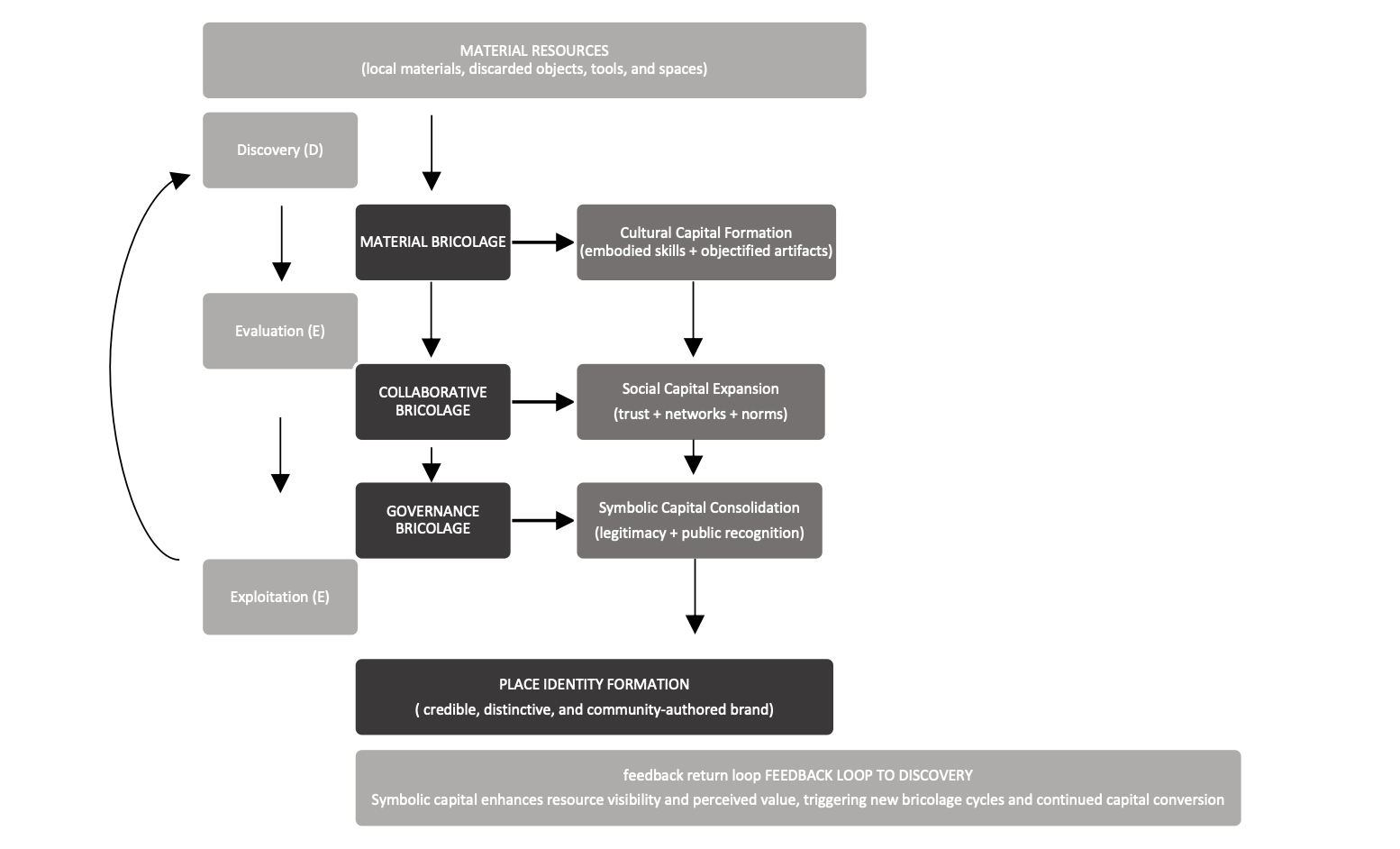
Regional branding in peripheral areas often emerges from necessity rather than strategic design. This study investigates the Zuojhen Lantern Festival (ZLF) in Tainan, Taiwan, to examine how bricolage—the creative recombination of available materials, skills, and social networks under constraint—contributes to cultural regeneration and regional identity. The research employs a qualitative case study approach, drawing on two semi-structured interviews, documentary sources, and field photography collected between 2024 and 2025. Guided by the Discovery–Evaluation–Exploitation (D–E–E) framework and Bourdieu’s capital theory, the analysis explores how communities transform limited resources into cultural, social, and symbolic capital through iterative creative practices. The findings reveal that material bricolage, such as the reuse of local bamboo and ecological elements, generated distinctive aesthetic expressions and strengthened environmental awareness. Social bricolage fostered collaboration among returning youth, local artisans, and district officials, reinforcing trust and collective authorship. Symbolic bricolage occurred as the festival gained wider recognition, translating cultural participation into regional brand value. The study concludes that bricolage serves as an adaptive mechanism that enables small communities to convert scarcity into creative potential, aligning grassroots innovation with sustainable regional revitalization. These insights offer practical implications for designing participatory, low-cost, and context-sensitive cultural strategies in similar peripheral settings.
Downloads
Article Details
Section

This work is licensed under a Creative Commons Attribution 4.0 International License.
How to Cite
References
Abe, Y., Yachin, J. M., & Ioannides, D. (2024). Rural microentrepreneurship and bricolage: The adaptive logic of. Small-scale tourism in Japan. Tourism Geographies, 26(2), 315–334. https://doi.org/10.1080/14616688.2023.2267581
Abe, Y., Yachin, J. M., & Ioannides, D. (2024). Rural microentrepreneurship and bricolage: The adaptive logic of. Small-scale tourism in Japan. Tourism Geographies, 26(2), 315–334. https://doi.org/10.1080/14616688.2023.2267581
Baker, T., & Nelson, R. E. (2005). Creating something from nothing: Resource construction through entrepreneurial. bricolage. Administrative Science Quarterly, 50(3), 329–366. https://doi.org/10.2189/asqu.2005.50.3.329
Bailey, C., Miles, S., & Stark, P. (2004). Culture-led urban regeneration and the revitalization of identities in Newcastle, Gateshead and the North East of England. International Journal of Cultural Policy, 10(1), 47–65. https://doi.org/10.1080/1028663042000212328
Bisani, F. (2024).Legitimacy and inclusivity in place branding: Reframing participation beyond representation. Journal of Place Management and Development, 17(2), 145–160.
Boisen, M., Terlouw, K., Groote, P., & Couwenberg, O. (2018). Reframing place promotion, place marketing, and place branding—Moving beyond conceptual confusion. Cities, 80, 4–11. https://doi.org/10.1016/j.cities.2017.08.021
Bourdieu, P. (1986). The forms of capital. In J. G. Richardson (Ed.), Handbook of theory and research for the sociology of education (pp. 241–258). Greenwood Press.
Campelo, A., Aitken, R., Thyne, M., & Gnoth, J. (2014). Sense of place: The importance for destination branding. Journal of Travel Research, 53(2), 154–166. https://doi.org/10.1177/0047287513496474
Chen, M.-L. (2021). Story of local revitalization in Taiwan by “Meiling-sister”(in Chinese). Commonwealth Publishing.
Clark, K. (2008). Informed conservation: Understanding historic buildings and their landscapes for conservation. English Heritage.
Creswell, J. W., & Poth, C. N. (2018). Qualitative inquiry and research design: Choosing among five approaches (4th ed.). SAGE Publications.
Cunha, M. P., Rego, A., Oliveira, P., Rosado, P., & Habib, N. (2014). Product innovation in resource-poor environments: Three research streams. Journal of Product Innovation Management, 31(2), 202–210. https://doi.org/10.1111/jpim.12089
Della Spina, L. (2025). Community branding and participatory governance: Cultural heritage as symbolic capital. Heritage, 8(1), 112–130.
Díaz-Soria, I., & Llurdés Coit, J. (2013). “Thoughts about proximity tourism as a strategy for local development.” Cuadernos de Turismo, 32, 303–305.
Duymedjian, R., & Rüling, C. C. (2010). Towards a foundation of bricolage in organization and management theory. Organization Studies, 31(2), 133–151. https://doi.org/10.1177/0170840609347051
Executive Yuan. (2019). Regional revitalization policy: Five Arrows Strategy. National Development Council, Taiwan.
Garud, R., & Karnøe, P. (2003). Bricolage versus breakthrough: Distributed and embedded agency in technology entrepreneurship. Research Policy, 32(2), 277–300. https://doi.org/10.1016/S0048-7333(02)00100-2
Gladwin, T. N., Kennelly, J. J., & Krause, T. S. (1989). Shifting paradigms for sustainable development: Implications for management theory and research. Academy of Management Review, 20(4), 874–907. https://doi.org/10.5465/amr.1995.9512280024
Gravari-Barbas, M., & Ren, C. (2022). Tourism imaginaries: Anthropological approaches. Channel View Publications.
Ijla, A., & Broström, T. (2015). The sustainable value of adaptive reuse of cultural heritage buildings. International Journal of Architectural Heritage, 9(4), 431–440. https://doi.org/10.1080/15583058.2013.774522
Johannisson, B., & Wigren, C. (2006). The dynamics of community identity making in an industrial district: The spirit of Gnosjö revisited. Entrepreneurship & Regional Development, 18(6), 499–523. https://doi.org/10.1080/08985620600884779
Kavaratzis, M., & Hatch, M. J. (2013). The dynamics of place brands: An identity-based approach to place branding theory. Marketing Theory, 13(1), 69–86. https://doi.org/10.1177/1470593112467268
Knight, J. (1994). Rural revitalization in Japan: Spirit of the village and taste of the country. Asian Survey, 34(7), 634–646. https://doi.org/10.2307/2645144
Landry, C. (2012). The creative city: A toolkit for urban innovators. Earthscan.
Langston, C., & Shen, L. Y. (2007). Application of the adaptive reuse potential model in Hong Kong: A case study of Lui Seng Chun. International Journal of Strategic Property Management, 11(4), 193–207. https://doi.org/10.1080/1648715X.2007.9637574
Lévi-Strauss, C. (1966). The savage mind. University of Chicago Press.
Lincoln, Y. S., & Guba, E. G. (1985). Naturalistic inquiry. SAGE Publications.
Massey, D. (1994). Space, place, and gender. Polity Press.
Matanle, P., & Rausch, A. S. (2011). Japan’s shrinking regions in the 21st century: Contemporary responses to depopulation and socioeconomic decline. Cambria Press.
Mbinza, J. (2024). Connecting place branding to social and governance challenges: Participation, legitimacy, and institutional capacity. Place Branding and Public Diplomacy, 20(1), 1–14.
National Development Council. (2019). Regional revitalization policy: The Five Arrows Strategy. Executive Yuan, Taiwan.
Pernecky, T., & Luck, M. (2013). Events, society and sustainability: Critical and contemporary approaches. Routledge.
Pike, A. (2009). Geographies of brands and branding. Progress in Human Geography, 33(5), 619–645. https://doi.org/10.1177/0309132508101601
Putnam, R. D. (2000). Bowling alone: The collapse and revival of American community. Simon & Schuster.
Qu, M., & Zollet, S. (2023). Rural art festivals and creative social entrepreneurship. Event Management, 27(8), 1219-1235.
Ray, C. (1998). Culture, intellectual property and territorial rural development. Sociologia Ruralis, 38(1), 3–20. https://doi.org/10.1111/1467-9523.00060
Richards, G. (2020). Designing creative places: The role of creative tourism. Annals of Tourism Research, 85, 102922. https://doi.org/10.1016/j.annals.2020.102922
Richards, G. (2021). Cultural tourism and creative place-making: Emerging narratives and practices. Tourism Geographies, 23(5–6), 1023–1041.
Ripoll González, A., & Kavaratzis, M. (2024). What does it take to co-create place brands? Capabilities, roles, and governance arrangements. Journal of Place Management and Development, 17(1), 23–41.
Roberts, P., & Sykes, H. (2000). Urban regeneration: A handbook. SAGE Publications.
Ryu, K., & Lee, T. J. (2021). Local festival participation and community resilience: A social network perspective. Tourism Management, 87, 104383. https://doi.org/10.1016/j.tourman.2021.104383
Wu, F., & Coe, N. M. (2023). Bottom-up cluster branding through boundary spanners: Cultural revitalization in Jingdezhen, China. Urban Studies, 60(12), 2365–2382.
Salmela, T., Nevala, H., Nousiainen, M., & Rantala, O. (2021). Proximity tourism: A thematic literature review. Matkailututkimus, 17(1), 46–63. https://doi.org/10.33351/mt.107997
Senyard, J., Baker, T., & Davidsson, P. (2014). Bricolage as a path to innovativeness for resource-constrained new firms. Journal of Product Innovation Management, 31(2), 211–230. https://doi.org/10.1111/jpim.12091
Shane, S., & Venkataraman, S. (2000). The promise of entrepreneurship as a field of research. Academy of Management Review, 25(1), 217–226.https://doi.org/10.5465/amr.2000.2791611
Yin, R. K. (2018). Case study research and applications: Design and methods (6th ed.). SAGE Publications.
Zbuchea, A., Pînzaru, F., & Corbu, N. (2022). Symbolic capital and place brand legitimacy: Recognition, narratives, and authority. Place Branding and Public Diplomacy, 18(4), 351–365.