
Monetary Policy Transmission, Inflation Dynamics, and Industrial Growth in China, 2018-2025
Article Sidebar
Main Article Content
Abstract
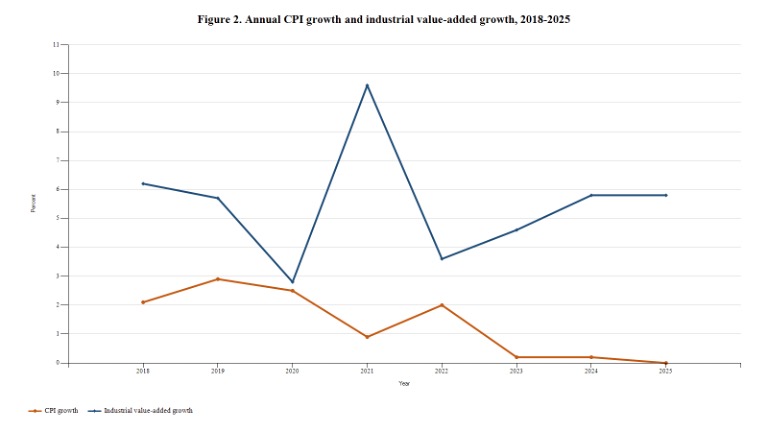
This paper analyzes the joint movement of monetary policy, inflation, and industrial growth in China during 2018-2025, with special attention to the post-2019 Loan Prime Rate (LPR) framework. It argues that the period should not be read simply as one of either policy success or policy failure. Instead, the evidence points to a regime of incomplete but still operative transmission. The one-year LPR moved downward after the 2019 reform, showing that China's monetary stance became more clearly accommodative. At the same time, inflation shifted from temporary pressure to a prolonged low-inflation environment, suggesting that weak domestic demand became a more important macro constraint than overheating. Industrial value-added growth remained resilient relative to the scale of shocks, but it normalized around a moderate range rather than returning to older high-speed patterns. Using official annual macro releases and relevant scholarship, the paper shows that lower rates helped stabilize the real economy, yet their effects on prices and activity were lagged, partial, and increasingly conditioned by structural adjustment. The main implication is that monetary easing remains necessary, but it cannot by itself restore a stronger growth-inflation nexus unless it is combined with demand-side support, expectation management, and productivity-enhancing industrial policy.
Downloads
Article Details
Section

This work is licensed under a Creative Commons Attribution 4.0 International License.
How to Cite
References
[1] People's Bank of China. Announcement No. 15 of 2019 of the People's Bank of China.
[2] Das, S., & Song, W. (2023). Monetary policy transmission and policy coordination in China. China Economic Review, 82, 102032. https://doi.org/10.1016/j.chieco.2023.102032
[3] Kamber, G., & Mohanty, M. S. (2018). Do interest rates play a major role in monetary policy transmission in China? BIS Working Paper No. 714.
[4] Yang, H., Zhang, Y., & Hamori, S. (2021). China's interest rate pass-through after the interest rate liberalization: Evidence from a nonlinear autoregressive distributed lag model. International Review of Economics and Finance, 72, 415-429. https://doi.org/10.1016/j.iref.2020.12.031
[5] Dreger, C., & Zhang, Y. (2013). Inflation in China increasingly driven by domestic factors. National Institute Economic Review, 223(1), R35-R38. https://doi.org/10.1177/002795011322300104
[6] Wang, H., Xu, N., Yin, H., & Ji, H. (2022). The dynamic impact of monetary policy on financial stability in China after crises. Pacific-Basin Finance Journal, 75, 101855. https://doi.org/10.1016/j.pacfin.2022.101855
[7] Ye, J., Zhang, A., & Dong, Y. (2019). Banking reform and industry structure: Evidence from China. Journal of Banking & Finance, 104, 70-84. https://doi.org/10.1016/j.jbankfin.2019.05.004
[8] National Bureau of Statistics of China. Statistical Communique of the People's Republic of China on the 2018 National Economic and Social Development.
[9] National Bureau of Statistics of China. Statistical Communique of the People's Republic of China on the 2019 National Economic and Social Development.
[10] National Bureau of Statistics of China. Statistical Communique of the People's Republic of China on the 2020 National Economic and Social Development.
[11] National Bureau of Statistics of China. Statistical Communique of the People's Republic of China on the 2021 National Economic and Social Development.
[12] National Bureau of Statistics of China. Statistical Communique of the People's Republic of China on the 2022 National Economic and Social Development.
[13] National Bureau of Statistics of China. Statistical Communique of the People's Republic of China on the 2023 National Economic and Social Development.
[14] National Bureau of Statistics of China. Statistical Communique of the People's Republic of China on the 2024 National Economic and Social Development.
[15] National Bureau of Statistics of China. (February 28, 2026). Statistical Communique of the People's Republic of China on the 2025 National Economic and Social Development.
[16] People's Bank of China and National Interbank Funding Center. Announcement No. 15 [2019] of the People's Bank of China and selected Loan Prime Rate releases, August 2019-November 2025.