Coffee and Sustainability in Tea-Drinking Societies: Cultural Path Dependence in China and Korea
Article Sidebar
Main Article Content
Abstract
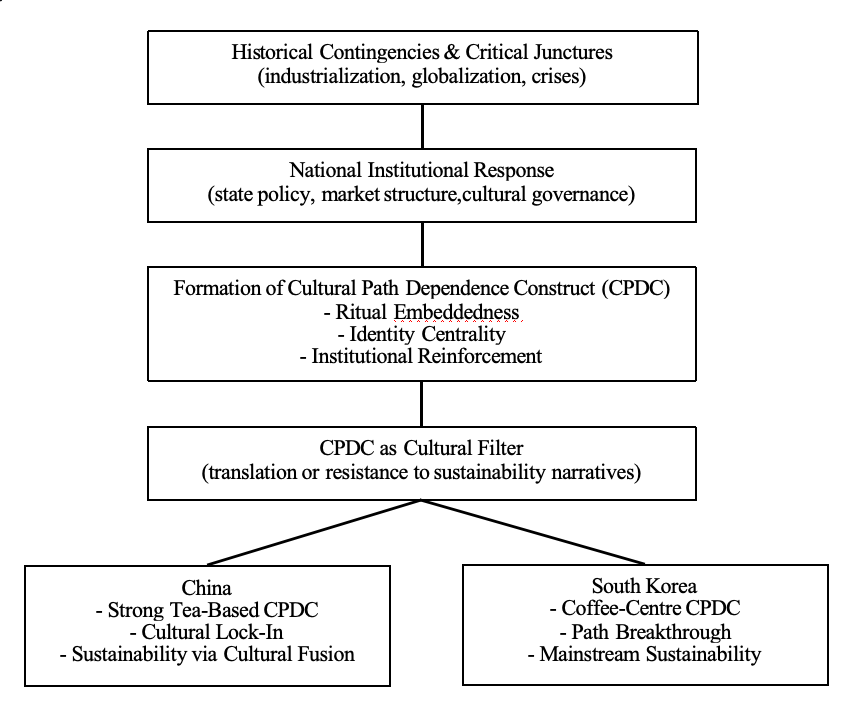
This study develops a theoretical framework to explain the different tracks of coffee consumption in China and South Korea, both of which are historically characterized by tea-dominant cultures, through the lens of cultural path dependence. Building on theories of institutional path dependence and cultural embeddedness, the paper introduces the Cultural Path Dependence Construct (CPDC), a second-order construct comprising ritual embeddedness, identity centrality, and institutional reinforcement. The CPDC framework captures how historically constituted cultural-institutional pathways act as filters that shape consumer receptivity to sustainability narratives. Through comparative analysis, the study theorizes China’s enduring tea dominance as a case of cultural lock-in and South Korea’s rapid embrace of coffee as a path breakthrough. The findings suggest that strong CPDCs limit the mainstreaming of sustainable innovations by requiring culturally congruent translation, while more fluid CPDCs allow for direct adoption. Based on this framework, a set of testable propositions is presented, along with a strategic matrix contrasting sustainable marketing approaches in locked-in versus breakthrough markets. The study offers theoretical contributions by linking path dependence with sustainable consumption to provide practical insights for firms aiming to localize sustainability messaging in culturally divergent markets. Meanwhile, the CPDC framework offers a new tool for understanding how cultural paths interact the success of sustainability-oriented market innovations.
Downloads
Article Details
Section

This work is licensed under a Creative Commons Attribution 4.0 International License.
How to Cite
References
1. Appadurai, A. (1986) The social life of things: Commodities in cultural perspective. Cambridge University Press.
2. Arthur, W.B. (1989) “Competing technologies, increasing returns, and lock-in by historical events,” Economic Journal (London, England), 99(394), p. 116. Available at: https://doi.org/10.2307/2234208.
3. Arthur, W.B. (1994) Increasing returns and path dependence in the economy. University of Michigan Press. Available at: https://sites.santafe.edu/~wbarthur/Books/IR_Book_Preface.pdf (Accessed: January 31, 2026).
4. Belk, R.W. (1988) “Possessions and the extended self in consumer behavior,” Journal of Consumer Research, 15(2), pp. 139–168.
5. Bourdieu, P. (1987) Distinction: A social critique of the judgement of taste. Translated by R. Nice. London, England: Harvard University Press.
6. Cho, W. et al. (2023) “Survival characteristics of food and beverage businesses in a gentrified commercial area-A case study in Seoul, Korea,” Heliyon, 9(11), p. e21514. Available at: https://doi.org/10.1016/j.heliyon.2023.e21514.
7. Curran, N.M. and Chesnut, M. (2022) “English fever and coffee: Transient cosmopolitanism and the rising cost of distinction,” Journal of Consumer Culture, 22(2), pp. 551–570. Available at: https://doi.org/10.1177/1469540521990869.
8. David, P.A. (1985) “Clio and the economics of QWERTY,” The American Economic Review, 75(2), pp. 332–337.
9. Galvani, C. (2024) The emerging consumption trends of tea and coffee in contemporary China, [Master dissertation, Ca’ Foscari University of Venice]. Available at: https://unitesi.unive.it/handle/20.500.14247/26651 (Accessed: January 31, 2026).
10. Gellert, P.K. (2005) “Grounds for Agreement: The Political Economy of the Coffee Commodity Chain,” Journal of World-Systems Research. Edited by J.M. Talbot, pp. 151–157.
11. Granovetter, M. (1985) “Economic action and social structure: The problem of embeddedness,” American Journal of Sociology, 91(3), pp. 481–510. Available at: https://doi.org/10.1086/228311.
12. International Coffee Organization (2023) Coffee market report. Available at: https://icocoffee.org/documents/cy2023-24/Coffee_Report_and_Outlook_December_2023_ICO.pdf (Accessed: January 31, 2026).
13. Jackson, T. (2005) “Motivating sustainable consumption,” Sustainable Development Research Network, pp. 1–170.
14. Larrea, S.B.V.V. (2022) Global Market Report: Coffee prices and sustainability, International Institute for Sustainable Develop-ment. Available at: https://www.iisd.org/publications/report/2022-global-market-report-coffee (Accessed: January 31, 2026).
15. Lee, H.-C. and Kwon, S.-H. (2022) “The invention and promotion of cha-rye in Korea,” Asian Journal of Social Science, 50(3), pp. 171–177. Available at: https://doi.org/10.1016/j.ajss.2022.06.004.
16. Li, R. et al. (2022) “More than a mere cup of coffee: When perceived luxuriousness triggers Chinese customers’ perceptions of quality and self-congruity,” Journal of Retailing and Consumer Services, 64(102759), p. 102759. Available at: https://doi.org/10.1016/j.jretconser.2021.102759.
17. Liu, J., Qian, C. and Li, X. (2024) “Livelihood and food security in the context of sustainable agriculture: Evidence from tea agri-cultural heritage systems in China,” Foods (Basel, Switzerland), 13(14), p. 2238. Available at: https://doi.org/10.3390/foods13142238.
18. Long, H. and Khan, M.S. (2025) “The impact of coffee growers’ Green Production Behavior in Yunnan province on sustainable agriculture development goals: A conceptual paper,” Journal of Lifestyle and SDGs Review, 5(2), p. e04186. Available at: https://doi.org/10.47172/2965-730x.sdgsreview.v5.n02.pe04186.
19. Martin, R. and Sunley, P. (2010) “The place of path dependence in an evolutionary perspective on the economic landscape,” in The Handbook of Evolutionary Economic Geography. Edward Elgar Publishing.
20. Meneses, E.J. (2025) Signature drinks fuel growth in Chinese specialty-coffee scene, Barista Magazine Online. Barista Magazine. Available at: https://www.baristamagazine.com/trends-from-chinas-specialty-coffee-scene/ (Accessed: January 31, 2026).
21. Na, H. et al. (2022) “Consumption of coffee and green tea and the risk of colorectal cancer in Korea: The Health Examinees study,” Journal of Cancer Prevention, 27(4), pp. 229–238. Available at: https://doi.org/10.15430/JCP.2022.27.4.229.
22. North, D.C. (1990) Political economy of institutions and decisions: Institutions, institutional change and economic performance. Cambridge, England: Cambridge University Press.
23. Pang, C.L. and Li, M. (2018) “Mapping Chinese coffee culture in the land of tea: The case of Yunnan Province,” Journal of Interna-tional Economic Studies, 32, pp. 103–115.
24. Park, S.W. and Yoon, H.H. (2017) “Effect of Values on Attitudes and Behavioral Intentions of Consumers towards Fair Trade Cof-fee-Moderating Effect of Ethical Consumption Consciousness,” Journal of the East Asian Society of Dietary Life, 27(3), pp. 257–267.
25. Peattie, K. and Crane, A. (2005) “Green marketing: legend, myth, farce or prophesy?,” Qualitative Market Research An International Journal, 8(4), pp. 357–370. Available at: https://doi.org/10.1108/13522750510619733.
26. Pierson, P. (2000) “Increasing returns, path dependence, and the study of politics,” The American Political Science Review, 94(2), pp. 251–267. Available at: https://doi.org/10.2307/2586011.
27. Ponte, S. (2002) “The `latte revolution’? Regulation, markets and consumption in the global coffee chain,” World Development, 30(7), pp. 1099–1122. Available at: https://doi.org/10.1016/s0305-750x(02)00032-3.
28. Qi, F., Qin, W. and Li, X. (2025) “Spatio-temporal expansion patterns and influencing factors in China’s new local retail industry: A case study of Luckin Coffee,” PloS One, 20(7), p. e0320933. Available at: https://doi.org/10.1371/journal.pone.0320933.
29. Raynolds, L.T. (2009) “Mainstreaming fair trade coffee: From partnership to traceability,” World Development, 37(6), pp. 1083–1093. Available at: https://doi.org/10.1016/j.worlddev.2008.10.001.
30. Rossi, D. (2018) Dragons drinking coffee: South Korean and Chinese coffee cultures, [Master dissertation, Università Ca’ Foscari Venezia]. Available at: https://unitesi.unive.it/handle/20.500.14247/2729 (Accessed: January 31, 2026).
31. Swidler, A. (1986) “Culture in Action: Symbols and Strategies,” American Sociological Review, 51(2), p. 273. Available at: https://doi.org/10.2307/2095521.
32. Tong, L., Toppinen, A. and Wang, L. (2021) “Cultural motives affecting tea purchase behavior under two usage situations in China: a study of renqing, mianzi, collectivism, and man-nature unity culture,” Journal of Ethnic Foods, 8(1). Available at: https://doi.org/10.1186/s42779-021-00092-6.
33. Ur Rahman, S. et al. (2023) “Cross-cultural perspective on sustainable consumption: implications for consumer motivations and promotion,” Environment Development and Sustainability, 25(2), pp. 997–1016. Available at: https://doi.org/10.1007/s10668-021-02059-8.
34. USDA-FAS. (2024) “Coffee: World Markets and Trade (December),” Foreign Agricultural Service.
35. Vermeir, I. and Verbeke, W. (2006) “Sustainable food consumption: Exploring the consumer ‘attitude – behavioral intention’ gap,” Journal of Agricultural & Environmental Ethics, 19(2), pp. 169–194. Available at: https://doi.org/10.1007/s10806-005-5485-3.
36. Vorotnikov, V. (2024) South Korea’s coffee market: optimistic yet intensely competitive, Tea & Coffee Trade Journal. Available at: https://www.teaandcoffee.net/feature/34173/south-koreas-coffee-market-optimistic-yet-intensely-competitive/ (Accessed: Janu-ary 31, 2026).
37. Wang, S. (2022) “The differences and integration between tea culture and coffee culture,” Studies in Linguistics and Literature, 6(3), p. 22. Available at: https://doi.org/10.22158/sll.v6n3p22.
38. Wang, Y. and Tian, R.G. (2022) “Face culture and conspicuous consumption: A case study of Wuyi rock tea drinkers in Chi-na,” Society [Preprint]. Available at: https://doi.org/10.1007/s12115-022-00664-5.
39. Warde, A. (2005) “Consumption and theories of practice,” Journal of Consumer Culture, 5(2), pp. 131–153. Available at: https://doi.org/10.1177/1469540505053090.
40. World Population Review (2026) Tea consumption by country 2026, World Population Review. Available at: https://worldpopulationreview.com/country-rankings/tea-consumption-by-country (Accessed: January 31, 2026).
41. Young, W. et al. (2010) “Sustainable consumption: green consumer behaviour when purchasing products,” Sustainable Develop-ment, 18(1), pp. 20–31. Available at: https://doi.org/10.1002/sd.394.
42. Zelizer, V.A. (2017) The social meaning of money: Pin money, paychecks, poor relief, and other currencies. Princeton, NJ: Princeton University Press.
43. Zhang, N. (2014) “Coffee market in China: trends & consumer strategies. A coffee industry market research of a traditional tea-drinking country,” in.
44. Zhi, H. and Chen, H. (2021) “Dependent or Independent: Exploring the Culture of Local Coffee Shops in China,” European Journal of Food Drink and Society, 1(2).
45. 임유정 (2024) 공차, 무서운 속도로 매장 증가…‘커피’ 대신 ‘티’ 성공할까, 데일리안. Available at: https://www.dailian.co.kr/news/view/1372639 (Accessed: January 31, 2026).
46. 徐宁 (2025) 《现制饮品新品策略研究报告2025》:茶饮、咖饮品牌近2000款新品上新方向揭秘-新华网, News.cn. Available at: https://www.news.cn/food/20250919/2f9b3a83eb1a4e65be8d3a4db21fa973/c.html (Accessed: January 31, 2026).