Changes in Australia’s Perception of External Threats—— Analysis Based on Lowy Institute Poll Reports from 2005-2023
Article Sidebar
Main Article Content
Abstract
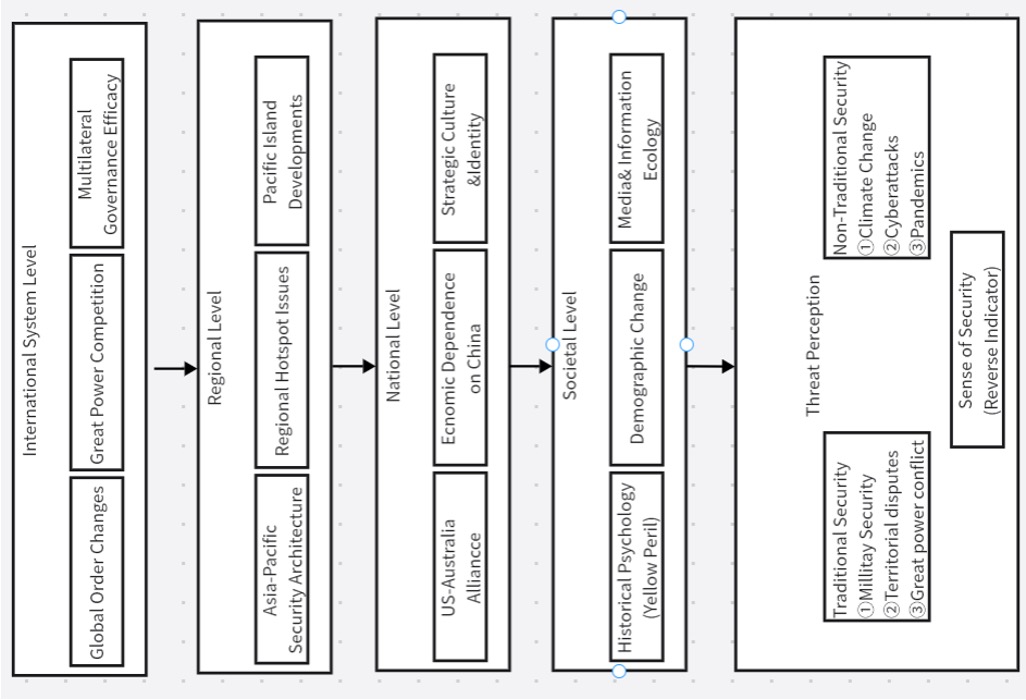
Based on the annual poll reports of the Australian Lowy Institute for International Policy from 2005 to 2023, and starting from the theoretical perspective of threat perception, this paper systematically sorts out and analyzes the evolution trajectory, typological characteristics, and driving factors of Australia’s external threat perception using a combined qualitative and quantitative research approach. The study finds that over the past nearly two decades, Australia’s overall sense of security has shown a significant downward trend, and its threat perception map has undergone a profound shift from a relatively optimistic “risk society” mentality to a highly vigilant “strategic anxiety society” mentality. In the traditional security domain, the focus of threat perception has shifted from international terrorism to major power geopolitical competition, with concern over land and maritime conflict risks (such as the Russia-Ukraine conflict, Taiwan Strait issue) rising sharply; in the non-traditional security domain, sensitivity and concern over threats such as climate change and cyberattacks have continued to intensify, and their scope and impact are perceived as continuously expanding. The perception of the threat from China has undergone a fundamental reversal from economic partner to primary security threat. The research provides a systematic attribution of this cognitive evolution from multiple dimensions including historical psychology, economic dependence, alliance politics, global order, and technological change. This paper concludes that Australia has formed a multi-layered threat perception consensus, which will continue to shape its future national security strategy and foreign policy direction.
Downloads
Article Details
Section

This work is licensed under a Creative Commons Attribution 4.0 International License.
How to Cite
References
1. Baldwin, D. A. (1971). Thinking about threats. Journal of Conflict Resolution, 15(1), 71–78. https://doi.org/10.1177/002200277101500106
2. Cohen, R. (1978). Threat perception in international crisis. Political Science Quarterly, 93(1), 93–107. https://doi.org/10.2307/2149052 -2
3. Grieco, J. M. (1988). Anarchy and the limits of cooperation: A realist critique of the newest liberal institutionalism. International Organization, 42(3), 485–507. https://doi.org/10.1017/S0020818300027715
4. Knorr, K. (1976). Threat perception. In Historical dimensions of national security problems (pp. 78–119). Lawrence: University Press of Kansas.
5. Singer, J. D. (1958). Threat perception and the armament tension dilemma. Journal of Conflict Resolution, 2(1), 90–105. https://doi.org/10.1177/002200275800200110
6. Susser, B. (1992). Psychology and politics. In B. Susser (Ed.), Approaches to the study of politics (pp. 345–365). New York: Mac-millan.
7. Wendt, A. (1999). Social theory of international politics. Cambridge: Cambridge University Press.
8. Zhang Qingmin. (2008). A review of the schools of international political psychology. International Political Science, 2008(3), 71–105.
9. Jointly compiled by twelve key normal universities. (2002). Fundamentals of psychology. Beijing: Educational Science Publish-ing House.
10. Zhai Shilei., & Xu Shanpin. (2022). The development, composition, and characteristics of Australian international affairs think tanks: From interest affiliation to intellectual dependency. Think Tank: Theory & Practice, 7(5), 120–130.